Articles · 2026-04-20
Wind Sensors Explained: Why a Good Awning Retracts Itself
An extended awning is a sail on a lever arm. Here is how a wireless wind sensor protects your investment automatically — and why we recommend one on every awning we install.
Why awnings and wind don't mix
A retractable awning extended over a patio is, mechanically speaking, a large fabric surface held out on articulated arms — a sail attached to your house by a lever. Wind loads on that surface multiply through the arms into the mounting brackets, and gusts add shock loading that steady wind does not. This is not a defect of any particular awning; it is the physics of every retractable awning ever made.
That is why the honest rule for awnings is simple and universal: retracted in wind. We do not publish a wind-speed rating for our awnings, and you should be skeptical of anyone who markets one — the responsible engineering answer is that an awning's storm posture is rolled up in its housing. A retracted Full-Cassette awning in a windstorm is completely protected; an extended one is at the weather's mercy. The entire game is making sure retraction actually happens, including when you are not home.
How the wireless wind sensor works
The wireless wind sensor we install mounts near the awning and continuously measures wind conditions. When gusts exceed its threshold, it radios the awning's motor directly, and the awning retracts itself — no app round trip, no cloud service, no human in the loop. The whole event takes under a minute from gust to safely stowed.
The scenarios it exists for are exactly the ones that catch people: the afternoon thunderstorm that spins up while you are at work in DC, the derecho-style gust front that crosses Loudoun County in minutes, the breezy day that turns while you are inside making lunch. Mid-Atlantic weather is famously fast-moving; the sensor is faster.
Setup, thresholds, and living with it
During installation we pair the sensor to the motor and set a sensible retraction threshold for your site — an exposed second-story deck in Winchester earns a more conservative setting than a courtyard patio in Old Town Alexandria. You can have the sensitivity adjusted later if the awning retracts more often than conditions seem to warrant; a slightly cautious sensor is doing its job.
Two maintenance notes. First, test it each spring: extend the awning, trigger a manual retract, and confirm the pairing still responds. Second, if the sensor is battery-powered, replace the battery on a calendar schedule, because a dead sensor fails silent, not safe. Every American Light Design awning style — Open-Roll, Semi-Cassette, Cross-Arm, and Full-Cassette — supports the sensor, and we consider it the single best accessory dollar on the order form.
Related products
Keep reading
Motorized Screen Cost in Northern Virginia (2026): Typical Prices and the Best Systems
Typical installed costs for motorized retractable screens in 2026, what drives the price, and which system fits your patio. Your firm quote is free.
Read more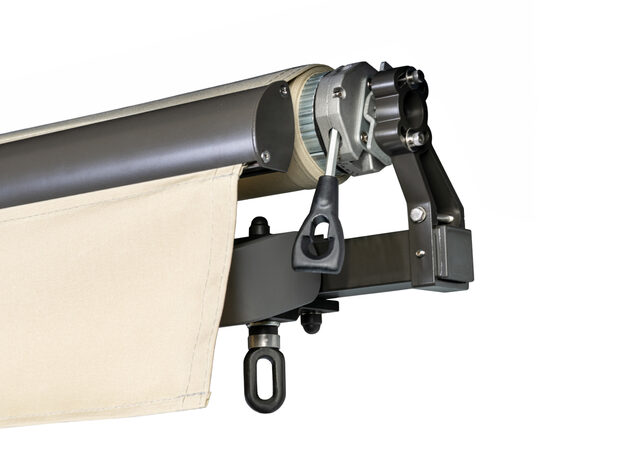
How do I adjust the pitch on an Open-Roll awning?
A manual crank sets the fabric angle — how pitch works, and when to change it through the seasons.
Read more
Where should an Open-Roll awning be installed?
Sheltered locations — under overhangs, soffits, and upper decks — and the honest rule for exposed walls.
Read more