Articles · 2026-05-28
Motorized Awning Anatomy: Open-Roll, Semi-Cassette, Cross-Arm, and Full-Cassette
The four American Light Design awning styles share the same bones — roller, arms, motor, Sunbrella fabric. What separates them is housing, geometry, and where each belongs.
The shared anatomy
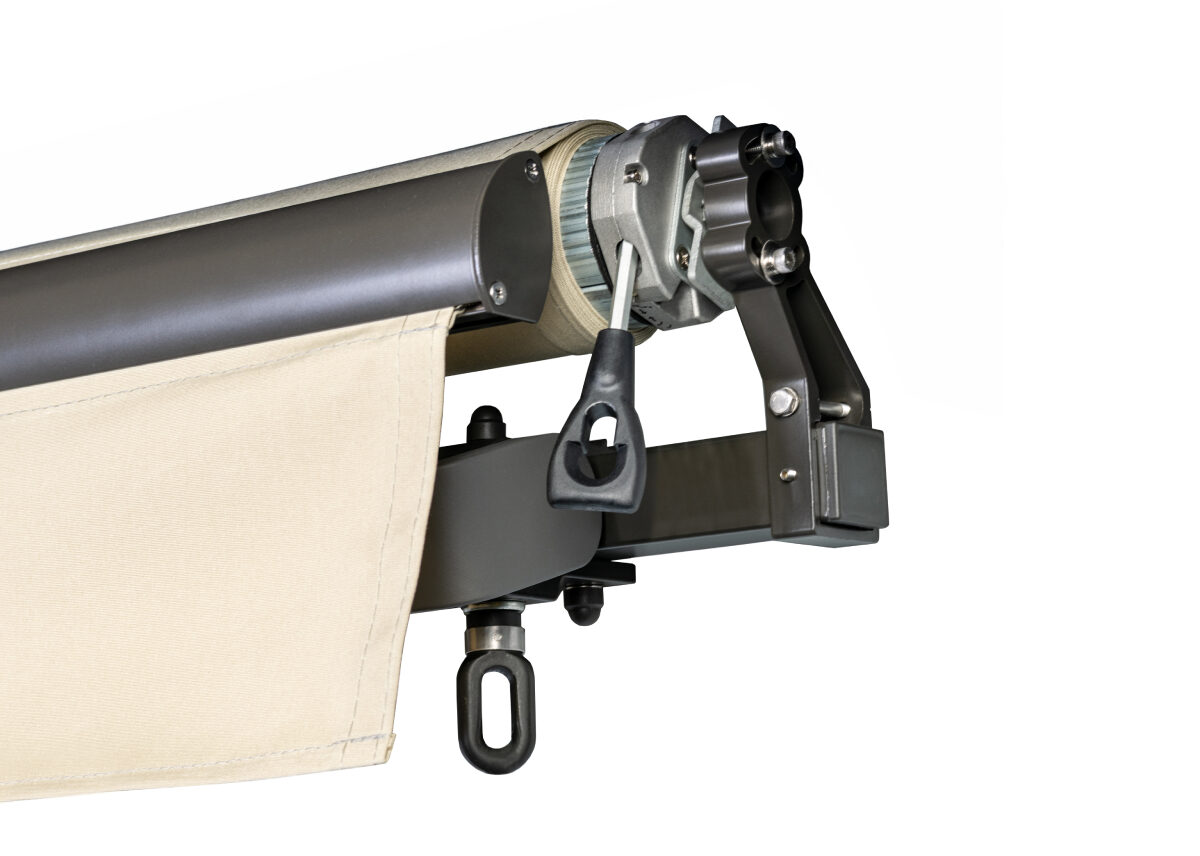
Every motorized retractable awning is built from the same functional parts: a roller tube that stores the fabric, a tubular motor hidden inside that tube, spring-tensioned folding arms that push the front bar out and hold the fabric taut, mounting brackets that carry the whole assembly on the wall or fascia, and the fabric itself. On our line the fabric is Sunbrella — the reference standard for outdoor textiles — in 30 in-stock patterns with more than 300 custom options, the motors are Dooya or Somfy tubular units, and the frames are anti-corrosion aluminum in white, bronze, beige, or black.
What actually differentiates the four styles is one question: how much of that anatomy is enclosed when the awning is retracted?
Open-Roll and Semi-Cassette: the open and the flagship
The Open-Roll is the simplest expression — roller and fabric exposed on the wall, with an optional hood covering roughly half. That simplicity makes it the budget-friendly choice, best under a roof overhang, soffit, or second-story deck where the structure above provides the weather protection the awning lacks. It comes in set sizes from 10 by 8 feet up to 20 by 10, pitch is adjusted by manual crank, and it carries a 5-year non-prorated, transferable warranty on hardware, fabric, and motor.
The Semi-Cassette is the flagship. Its housing wraps the top and sides of the rolled fabric — shielding it from sun and rain falling from above, which is most of what an awning endures — while remaining open underneath. It is built to custom widths from 9 feet 6 inches all the way to 40 feet with projections of 8, 10, or 12 feet, adds integrated dimmable LED arm lighting, EZ-Pitch angle adjustment, a removable straight or sea-wave valance, and steps up to the 10-year non-prorated, transferable warranty.
Cross-Arm and Full-Cassette: geometry and armor
The Cross-Arm is the Semi-Cassette build solving a geometry problem. Standard folding arms cannot project farther than the awning is wide — the arms would collide. The Cross-Arm crosses them over each other, so an awning as narrow as 8 feet can project up to 12 feet. If you have a narrow townhouse deck or a deep, skinny patio, this is the style that shades it; nothing else in the line can.
The Full-Cassette is maximum armor: fabric, arms, and roller retract into a fully enclosed square housing with clean, contemporary lines and no valance. For exposed mounting locations with no overhang, or for owners who simply want the longest-lived installation, full enclosure means the fabric spends its stored life sealed away from weather entirely. It comes in set sizes from 12 by 10 up to 20 by 12 feet, includes the LED arm lighting, and carries the 10-year warranty. All four styles motorize, pair with the wireless wind sensor, and are assembled in Florida, USA.
Related products
Keep reading
Motorized Screen Cost in Northern Virginia (2026): Typical Prices and the Best Systems
Typical installed costs for motorized retractable screens in 2026, what drives the price, and which system fits your patio. Your firm quote is free.
Read more
How do I adjust the pitch on an Open-Roll awning?
A manual crank sets the fabric angle — how pitch works, and when to change it through the seasons.
Read more
Where should an Open-Roll awning be installed?
Sheltered locations — under overhangs, soffits, and upper decks — and the honest rule for exposed walls.
Read more